We will be taking part in the anti-fascist marches scheduled to take place in Milan (Corso Venezia, on the corner of Via Palestro, at 2.30 pm) and Bologna (Piazza dell’Unità, at 10.00 am)
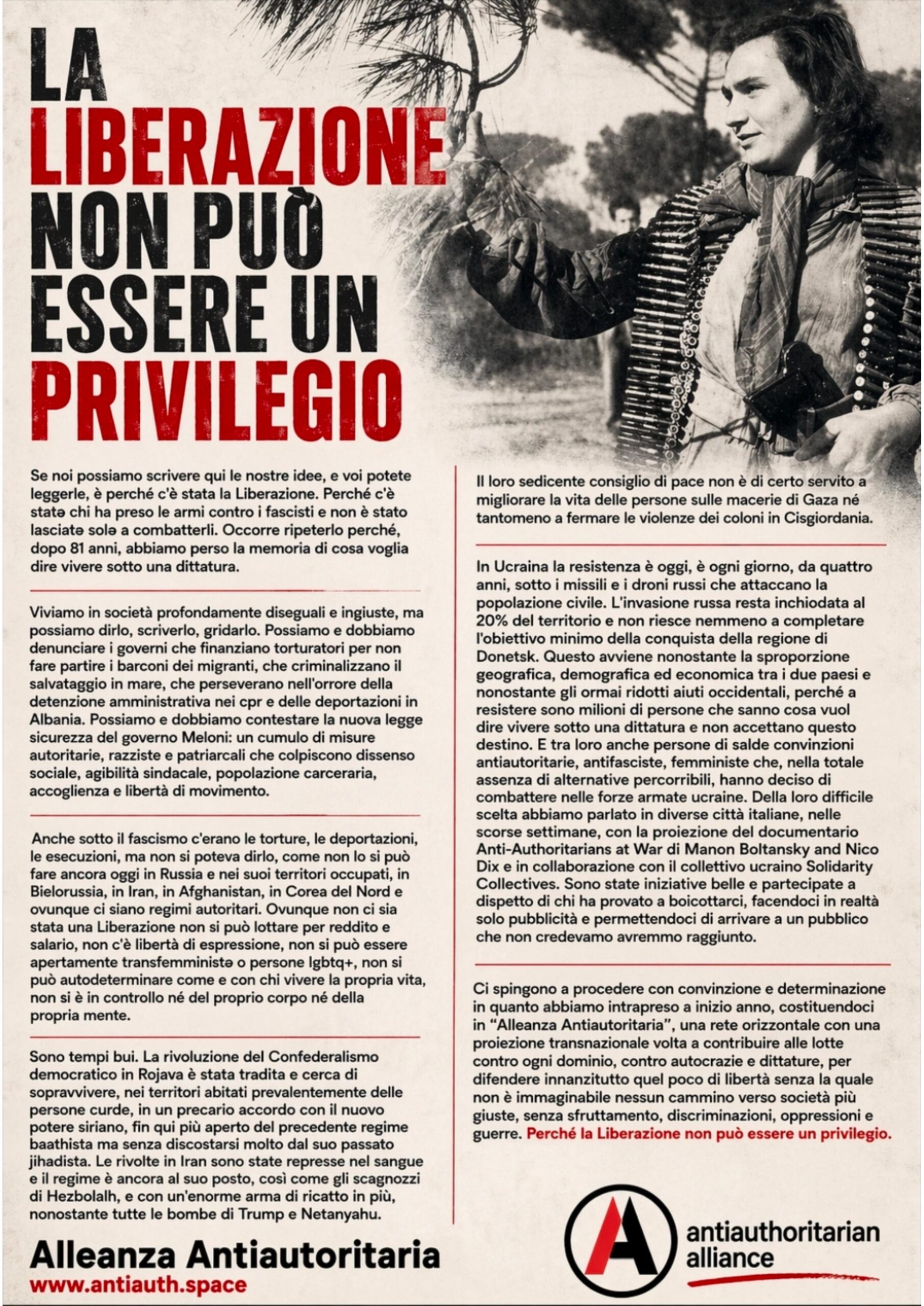
 If we are able to write our thoughts here, and you are able to read them, it is because of Liberation. Because there were those who took up arms against the fascists and were not left to fight them alone. We must repeat this because, 81 years on, we have lost the memory of what it means to live under a dictatorship.
We live in deeply unequal and unjust societies, but we can say it, write it, shout it. We can and must denounce governments that fund torturers to prevent migrant boats from setting sail, that criminalise rescue at sea, that persist with the horror of administrative detention in CPRs and deportations to Albania. We can and must challenge the Meloni government’s new security law: a collection of authoritarian, racist and patriarchal measures that target social dissent, trade union activity, the prison population, reception and freedom of movement.
Even under fascism there was torture, deportation and execution, but one could not speak of it, just as one cannot do so today in Russia and its occupied territories, in Belarus, in Iran, in Afghanistan, in North Korea and wherever there are authoritarian regimes. Wherever there has been no Liberation, one cannot fight for income and wages; there is no freedom of expression; one cannot openly identify as a transfeminist or an LGBTQ+ person; one cannot self-determine how and with whom to live one’s life; one is in control neither of one’s own body nor of one’s own mind.
These are dark times. The revolution of Democratic Confederalism in Rojava has been betrayed and is struggling to survive, in territories predominantly inhabited by Kurdish people, under a precarious agreement with the new Syrian regime, which has so far been more open than the previous Ba’athist regime but without straying far from its jihadist past. The uprisings in Iran have been brutally suppressed and the regime remains in place, as do Hezbollah’s henchmen, and with an enormous additional weapon of blackmail, despite all the bombs dropped by Trump and Netanyahu. Their so-called peace council has certainly not served to improve people’s lives amidst the rubble of Gaza, nor has it stopped the violence of the settlers in the West Bank.
In Ukraine, the resistance is taking place today, every day, for the past four years, under Russian missiles and drones attacking the civilian population. The Russian invasion remains confined to 20% of the territory and has not even managed to achieve the minimal objective of conquering the Donetsk region. This is happening despite the geographical, demographic and economic disparity between the two countries and despite the now-reduced Western aid, because the resistance is made up of millions of people who know what it means to live under a dictatorship and refuse to accept this fate. Among them are people with firm anti-authoritarian, anti-fascist and feminist convictions who, in the total absence of viable alternatives, have decided to fight in the Ukrainian armed forces. We have spoken about their difficult choice in various Italian cities over the past few weeks, with the screening of the documentary *Anti-Authoritarians at War* by Manon Boltansky and Nico Dix, in collaboration with the Ukrainian collective Solidarity Collectives. These were wonderful, well-attended events, in spite of those who tried to boycott us – in reality, they only served to publicise us and allowed us to reach an audience we never thought we would reach.
They spur us on to proceed with conviction and determination in what we set out to do at the start of the year, establishing ourselves as the ‘Anti-Authoritarian Alliance’, a horizontal network with a transnational reach aimed at contributing to the struggles against all forms of domination, against autocracies and dictatorships, to defend, above all, that little bit of freedom without which no path towards fairer societies—free from exploitation, discrimination, oppression and war—is conceivable. Because liberation cannot be a privilege.