
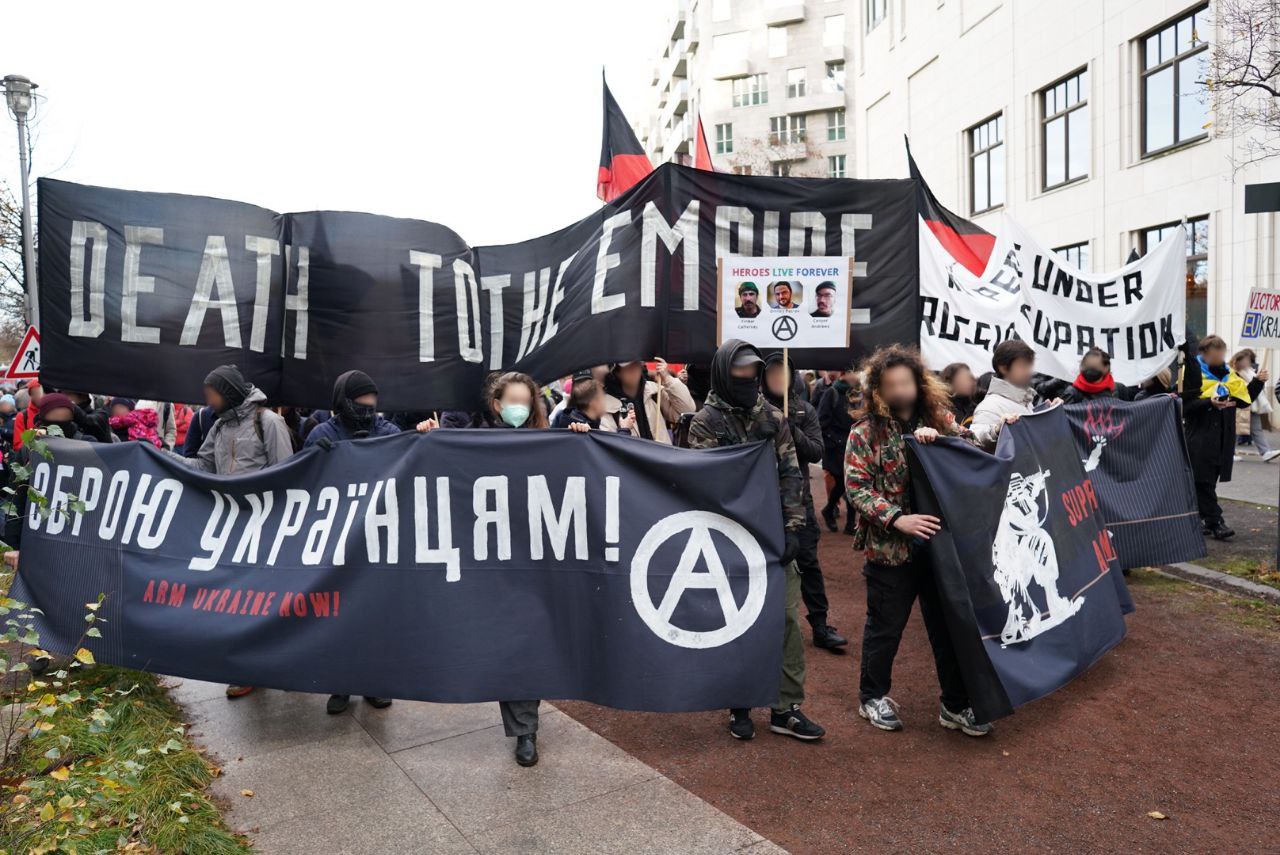
The intensity, violence, and hatred of the campaign unleashed on social media (and echoed by parts of the local press) following the announcement of the Bologna screening of “Antiauthoritarians at War”—a documentary about the participation of anarchist and anti-authoritarian militants in the Ukrainian resistance—are striking. We confirm the event for next Friday, April 10, starting at 7:00 PM at Làbas, in Vicolo Bolognetti 2, with the participation of an activist from the Ukrainian association Solidarity Collectives.
On the one hand, we are tempted to thank all our detractors for this textbook case of the Streisand effect: we could never have achieved such publicity for our initiative on our own. On the other hand, we believe it is necessary to address a few points.
First of all, it is truly shocking to see how far the Bologna Federation of the Rifondazione Comunista Party has fallen. Even those among us who viewed this organization with suspicion during the days of the Genoa G8 and the Social Forums would never have imagined it would go so far as to call for intervention by the municipality against a self-managed community space —moreover using, quite suggestively, a 2020 photo of the Azov Regiment to associate with the far right those who have, for decades, put their bodies and faces on the line against all forms of fascism.
Secondly, the ad personam campaign launched against Maryana Trofymova is unacceptable. We have known her for some time thanks to the relationship of reciprocity and mutual support established with the Ukrainian community in Bologna, with whom we maintain open lines of communication, which we of course activated to exchange views and advice during the days when we were twice denied the possibility of hosting the screening. Although she was not involved in organizing the initiative nor scheduled as a speaker in the discussion, Maryana spontaneously chose to use her social media channels to denounce what was happening, and we thank her greatly for that.
To attack her, posts from years ago were dug up, and based on these she was accused of being a supporter of Nazism. While no one here underestimates the danger of Nazi and fascist ideas—whether in Ukraine, in Italy, or anywhere else—and while anti-authoritarian individuals in Ukraine have always reminded us that those who oppose Russian aggression from far-right positions will again become a danger the day after the war ends, it is necessary to dismantle a persistent myth. The “Azov Battalion,” which was indeed a neo-Nazi militia, has not existed since November 2014, when it became a regiment (and later a brigade) of the National Guard under the control of the Ministry of the Interior. Since then, neo-Nazis have not disappeared, but have gradually moved into other organizations, and Azov—while retaining an openly nationalist ideology—has become much larger, more diverse, multiethnic, and multiconfessional. In March 2022, Azov publicly renounced Nazism. In those same early months of the war, it fiercely defended the city of Mariupol for three months against the Russian offensive, tying down invading forces and preventing them from advancing on other fronts. When it was defeated, its fighters were all captured, and we now know that the Geneva Convention was blatantly disregarded in their case. Those who returned to Ukraine through prisoner exchanges were emaciated and bore signs of torture. The “crime” attributed to Maryana is that years ago she demonstrated for the release of these individuals.
All of this is entirely ignored by those who deny Ukrainians the right to resist and who, on social media, repeatedly publish the same photographs of swastikas from 12 years ago or more to support arguments that closely echo the “denazification” narrative repeated by Putin, Lavrov, and others for the past four years.
One crucial piece of the puzzle is still missing. The defamation campaign against Maryana—as well as the one targeting researcher Davide Grasso, who took part a few days ago in the documentary screening in Turin; the long-standing portrayal of Solidarity Collectives as “so-called anarchists commanded by Nazis”; and the attacks against journalist Claudio Locatelli—all have a very specific origin: the Telegram channel “Comitato Donbass Antinazista.” Its content has been reshared or copy-pasted across various platforms and even in press releases. On the surface, it appears anonymous and presents itself as an expression of the Italian extra-parliamentary left. However, even a relatively simple open-source investigation allows one to follow the thread to another Telegram channel—this time Russian—called “Cyber Front Z.” Four years ago, an investigation by the St. Petersburg outlet Fontanka linked it to a “troll factory” in St. Petersburg that paid individuals to spread disinformation in Europe. In a post dated April 21, 2022, it announced: “To coordinate joint actions, Cyber Front Z establishes the Unified Information Front […] bringing together administrators of foreign resources, whose efforts will be directed at breaking the information blockade of the Russian Federation and working toward a foreign audience. Our Italian friends have already joined us; they organized the movement ‘Committee for an Anti-Nazi Donbass’ to expose Ukrainian fake news and counter anti-Russian hysteria.” It would therefore be desirable to exercise greater care in choosing sources for political polemics.
For our part, we remain firmly alongside those who struggle against autocracies and dictatorships, in defense of the limited freedoms we still possess—without which no path toward more just societies, free from exploitation, discrimination, oppression, and war, can be imagined. This is what we will discuss on Friday.