
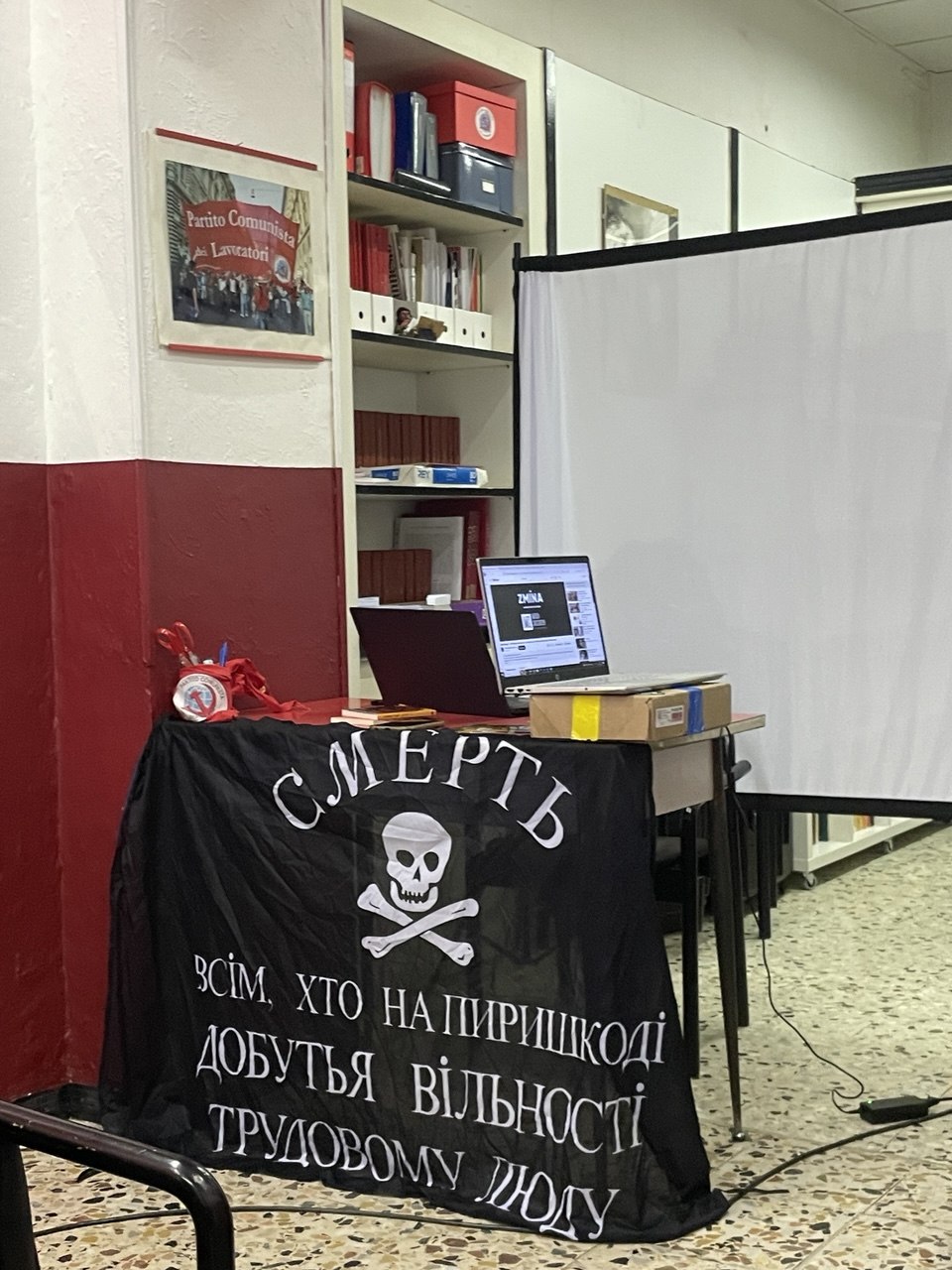
 We can consider ourselves satisfied with the first date of the Solidarity Collectives tour in Italy, which took place in Turin and is continuing these days in the cities of Bari, Padua, Bologna, Florence, and Milan (and maybe will have a spin-off in Perugia). As we write, the smear machine is already at work on Bologna; this time, the Stalinist machine is driven by the Bologna’s federation of Rifondazione Comunista party, fueled by the Telegram channel “Comitato Donbass Antinazista” with a piece of Russian propaganda fake news that already promises to backfire.
We thank those who hosted us, the “Vito Bisceglie” section of the Partito Comunista dei Lavoratori, also for sharing a moment of historical reflection by citing—consistent with their political tradition—Trotsky and his polemic with the Stalinists regarding the Sino-Japanese War. While asserting independence from the bourgeois government of Chiang Kai-shek, he saw Japan as an aggressive imperialist power whose victory would have imposed a “regime of slavery” on the Chinese people. The founder of the Red Army did not mince words in defining the misleading interpretation of revolutionary defeatism by the Stalinists.
We thank Davide Grasso for his contribution not only during the debate interventions, but also among participants in informal moments, offering insights and ideas to build paths in which the left as a whole can still act as a barrier against the spread of supremacist authoritarianisms that, now more than ever in the past century, are reaching a peak.
We of course thank all participants, especially those who respectfully and sincerely expressed their doubts on a political and strategic level, and we apologize for not being able to provide updates for a long time, given that the venue was withdrawn a week before the scheduled date.
We thank the comrades who were outside protesting, because they limited themselves to a few slogans, and the threats to prevent the meeting from taking place by any means did not materialize. Certainly, even without a venue, we would have known how to claim and defend our spaces for speech, but we are glad that this was not necessary.
Before starting, with the usual last-minute technical issues, we invited them to participate, but they preferred chanting from outside. Slogans such as “no to war” were directed against Ukrainians, who, according to some, would be happy to be bombed to please NATO. We heard calls for desertion, although no one in the room was in the army. Strangely, none of them thought to direct these chants in front of the ARCI club and ANPI section “La Poderosa,” where a war propaganda initiative clearly linked to the Russian government took place (the recent trip of Prof. D’Orsi to Moscow, invited by RT) and the promotion of the book “De Russofobia” with a preface by Maria Zakharova. Nor were they heard when the journalist Giorgio Bianchi (former candidate in a list of both far right and far left wing) performed in the city, known for questionable conduct regarding the laws of war in his interviews with Ukrainian prisoners (civilian and military), later fed into Russian government propaganda.
As for desertion, we would be glad to learn about the concrete solidarity initiatives toward Ukrainian and Russian deserters that our protesters have carried out so far, because an internal survey within the alliance found none. If any of them intends to contribute concretely—beyond slogans unheard at a distance of 2,000 to 5,000 kilometers—there might be room for collaboration. But we warn them that they will face harsh reality: desertion must be handled with extreme care to protect the freedom, and in some cases the very lives, of those fleeing their countries to avoid mobilization—whether overt, as in Ukraine, or more subtle but no less systematic, as in Russia.
We hope that soon we will be able to offer the opportunity to meet deserters, saboteurs, and those comrades whom our protesters claim to support. Meanwhile, we read in the press releases that have already been issued about an imaginary mass movement of deserters, guerrilla actions, and a full-fledged social revolution that is supposedly taking place, as we write, in Ukraine—and likely in Russia as well. Unfortunately, when analysis is based not on facts but on the desires and vivid imagination of those living here (perhaps fed by someone seeking approval), the only result is to launch an assault on windmills, mistaking them for giants.
We do not thank those who smear our comrades with defamatory campaigns and cowardly behavior. We must report that photographs were taken of our comrades from the protest, while loud slanderous accusations were directed at our guest and especially at a young Ukrainian refugee, an anarchist comrade who has been in Italy for three years, not part of the Alliance or the Solidarity Collectives, present on an individual basis. After refusing dialogue and labeling us as enemies, well-known figures of the FAT incited their small group against a SC comrade and this refugee, accusing them of being among the supposed “aggressors” of Anarchy2023 in Saint-Imier, shouting “ask them what happened in Saint-Imier!”
Not only did we ask this publicly during the meeting, but we also sought confirmation on various local websites (we apologize in advance to the respective editorial teams if the FAT revokes their “anarchist credentials”). We will also make every effort to obtain audio recordings of the incident from the relevant editors and, if necessary, update this page. For the moment, we can only note the convergence of accounts provided by four different sources that confirm our guest’s version.
We quote from Crimethinc:
For us, the biggest clash was on the topic of the war in Ukraine. It exploded on the second day at a round table discussion about Ukrainian resistance to the invasion. The organizers were not interested in discussing “whether” to support Ukrainian resistance; they wanted to talk about “how.” Certain self-proclaimed anti-militarists did not accept this; in the end, they screamed about censorship, saying things like “You don’t know what anarchy is!”
Several so-called anti-militarist events took place during the week, as well, and those were not disrupted by those who support anti-authoritarian fighters on the front in Ukraine. But at the panel discussion about anti-authoritarian perspectives on support for the Ukrainian resistance, some calling themselves an anti-militarist group tried to sabotage the event. There was screaming and shoving, which retraumatized people from Ukraine who were on the podium to speak. They laughed aloud during a minute of silence for our comrades who died fighting against Putin. It was ugly and contrary to solidarity, or even human decency. But still, at the end of the day, there were many more people ready to listen the experiences of anarchists directly affected by the war and Putin’s imperialism. There were many voices of solidarity from all over the world, and that was empowering.
Our guest also reported that Petrov’s parents (anarchist comrades like their son) were present during the moment of silence for the comrades who fell in Bakhmut while fighting the armed fascists of Wagner. We found confirmation of their presence in this interview in German.
The incident sparked a reaction from comrades who identify as Russian-speaking (to use the terminology of Western ethnic prejudices)—that is, anarchist groups of European and Asian Russians—who issued a lengthy statement on the matter:
It is important to note that throughout the war years, there was no constructive discussion at the movement level to develop coordinated and cohesive stances and actions. This led to lack of practical solidarity and to superficial analysis. This also led to people trying to dictate what the Ukrainian anarchists should be doing, although these people themselves often do not know the practical reality of this war. This reveals a terrible lack of understanding and camaraderie within the movement. In addition to event disruptions, the problem got to the point of deliberate laughter during a minute of silence in memory of the deceased comrades. Such cases emphasize that we do not always remember who our enemy is. The authorities thrive on our separation, lack of respect for the deceased comrades, and hostile attitude towards each other. Discrepancy in tactics and views is inevitable for a revolutionary movement, but our enemies should not be allowed to use it.
And a report by a Belarusian refugee
The panel discussion of several ABC groups and Solidarity Zone in the big hall was a concentration of different tactics of sabotage trying to prevent people from Ukraine/Belarus/Russia from speaking. Starting with a small group of Germans who tried to put their anti-militarist posters next to the stand of the Solidarity collectives during the event (which provoked a conflict with some Ukrainian comrades not because of anti-militarism, but because of the kind of anti-militarism these people stand for), and ending with people shouting in their language without any translation at the people sitting on the panel. The most disturbing and heartbreaking moment was certainly when at least one so-called anarchist laughed during the moment of silence in memory of comrades and other people who fell victim to Russian imperialist aggression. I’m not sure if there is any political movement in the world that can tolerate such ignorance and arrogance. And even in such a situation no violence was used against this person by the Ukrainian, Belarusian or Russian comrades.
This situation and attitude are familiar to us—we experienced them in the days leading up to the tour.
It is worth noting the vast disconnect from society and reality shown by those trying to impose their idea of anti-militarism: there appeared to be no Ukrainian or Russian comrades among the protesters. On the contrary, Ukrainian and Russian comrades living in Italy attended our meeting, appreciated our efforts, and supported us in difficult moments.
Anyone who was expecting to protest against none other than Giorgia Meloni as a surprise guest at the event will be disappointed. We must in fact remind (the protesters, not Meloni) that in 2014, the current Prime Minister wrote on social media, “It is right that the people should decide the future of Crimea through a referendum.” https://x.com/GiorgiaMeloni/status/439773609427738625 (the space before the .com domain is intentional).
Among the international observers of that referendum was the current regional councilor Maurizio Marrone, who, as a reward, received a medal for European fascist valor in Sevastopol and was appointed consul of occupied Crimea. The FdI party itself recruited Irina Osipova into its ranks, a candidate in the 2016 Rome municipal elections whose name appears in judicial investigations into the recruitment of Italian mercenaries for the war in Donbass (naturally on the Russian side), links to far-right circles in Russia and Italy, and who returned to the headlines in 2023 after being hired as an auditor in the Senate. We should also recall that elements have defected from the relative majority party who now boast on their propaganda pages about the assassination of Russian deserters across Europe.
If we were therefore to apply the same yardstick and the same arguments to our detractors, we could say that they can go to Salvini to seek solidarity in order to prevent the dispatch of military aid to Ukraine (in which, incidentally, Italy plays only a very minor role).
The question that arises at that point is a different one: are they therefore willing to take political responsibility for the deaths of all those people who are far from the front lines and not participating in the conflict but are being killed daily by Russian missiles and drones?
Since the isolationist and pacifist Trump took office in early 2025, the United States has been sending air defense systems and ammunition only upon purchase by European countries, significantly weakening Ukraine’s defense capabilities. The concrete effects on people’s lives were not long in coming. According to the report by the United Nations Human Rights Monitoring Mission in Ukraine (an agency established in Ukraine in 2014 by the UN), 2025 was the year with the highest number of civilian deaths in Ukraine since 2022, The total number of civilians killed and wounded in 2025 was 31% higher than in 2024 (when military aid was blocked for 8 months due to Republican obstruction in the House) and 70% higher than in 2023. The vast majority of civilian casualties verified by the HRMMU in 2025 occurred in territory controlled by the Ukrainian government as a result of attacks launched by Russian armed forces (97% of total civilian casualties).
If one decides that these thousands of lives are expendable in the name of ideological purity, one is doomed to remain a “militant of theory,” unable to affect reality. Following the teachings of Leshy Petrov, we are not interested in an abstract, otherworldly anarchism—we are interested in anarchism here and now.
One of the main reasons anarchists and non-anarchists founded this alliance was because there was a need for a honest debate on the urgency of fighting against authoritarianism of every stripe and political guise, beyond personal ideas and ideologies.
We consider the total refusal by elements of the anarchist movement to join this struggle to be inherent to the isolation—not only political—of certain fringes of the movement, but from political reality as a whole.
When trapped into superficial frameworks for interpreting the reality of what is happening in the struggles on the ground, of the will for self-determination of the populations where anarchists are present and struggle at various levels (from Rojava to Donbass), when one is arrogant in one’s claim to be the sole interpreter of the political legitimacy of diverse readings of a thought system as profound and nourished by different yet not mutually exclusive visions as anarchism, one can easily shift from total irrelevance to political harmfulness.
No one kicked us out of Turin. Thanks to the opportunities we were given, we demonstrated through our actions the merit of our ideas.
It is painful to note the ignorance of comrades who, despite certainly not lacking historical knowledge, issue militant declarations against others comrades who are doing nothing different from what many anarchists did right in the neighboring Sarzana area when they fought on the same side of the battle as the Allied powers. Was the Lucetti Battalion also a servant of American imperialism? The answer was yes for many in the same Malatesta-inspired current to which the FAT belongs. It is well known that Malatesta, through his relationship with the dockworkers of Giuliacci, held an ambiguous view of early fascism and publicly expressed positions in which he asserted a substantial equivalence between fascist regimes and democratic states.
Malatesta and all anarchists would have preferred it if history had stopped in the 1920s, but unfortunately that was not the case. The military brutality and ideological fanaticism of fascism’s authoritarian rule devoured dissidents and those who did not conform to its vision, regardless of their political, cultural, or gender identity. It swallowed millions of corpses of Jews, anarchists, communists, homosexuals, Poles, Italians, and Ukrainians (to name just a few). And many anarchist comrades of that era made a difficult choice—often criticized by their own comrades in arms—to stand against that horror. Sometimes they did so by directly aiding those very forces they never wanted to join; sometimes by enlisting militarily because they had no choice; and sometimes they even did so by joining formations ideologically at odds with their own ideals (think of “Bandiera Rossa” in Rome). And the German Freikorps had already swallowed their pride in the aftermath of World War I, as had the Arditi in Italy. If this continues to elude those who claim to be Malatesta’s heirs, it is no surprise that today they fail to grasp the murderous, freedom-destroying, and expansionist nature of Russian imperialism, nor that they try to ignore the anarchist comrades who are crying out and dying because of it.
The importance of uniting in a united front against these authoritarian forces, which are emerging with increasing violence in Ukraine as well as in Palestine, is not lost on the many comrades who have decided to stand their ground in this war by offering us solidarity and support. And for this, once again, we thank everyone.